In the field of affiliate marketing, many affiliate marketers encounter a frustrating problem: newly registered accounts are quickly linked to previously banned accounts and then restricted or banned directly. From the perspective of platform risk control, there is a fixed mechanism for account association and banning.
Today, we will explain to you why affiliate marketing accounts are more prone to association and banning, as well as the real reasons, from three aspects: platform rules, technical identification mechanisms, and the industry characteristics of affiliate marketing.

I. What Is Account Association? What Are Platforms Preventing?
Account association does not simply mean that multiple accounts are registered by the same person; it refers to the platform using technical means to determine whether multiple accounts are controlled or operated by the same person behind the scenes. For most advertising platforms, e-commerce platforms or social media platforms, the only goal of association risk control is to prevent a single person from using multiple accounts to undermine the platform's ecosystem.
Affiliate marketing itself is not illegal, but it has the following characteristics:
Multi-account operation
High dependence on conversion and delivery efficiency
Obvious profit motivation
Prone to risky behaviors such as arbitrage, fake traffic generation and gray hat traffic diversion
Therefore, affiliate marketing accounts or platforms are generally in the high-sensitivity zone of the risk control system.
II. Why Are Affiliate Marketing Accounts Easily Judged as Fraudulent Accounts?
From the perspective of platform algorithms, many affiliate marketing behaviors are highly similar to illegal behaviors in terms of characteristics. For example, it is reflected in the following aspects:
1. Multi-account Operation Is the Norm
Ordinary users: one account, long-term use, and naturally scattered behaviors. Affiliate marketers: operating multiple accounts simultaneously, with similar content and links appearing repeatedly, and short account lifecycles. In the risk control system, multi-account and similar behaviors are inherently high-risk signals.
2. Highly Single Traffic Path
The behavior path of ordinary content accounts is usually: browsing → interaction → occasional link clicks. However, the path of affiliate marketing accounts is often: exposure → click → redirect → conversion. This highly utilitarian and single-target behavior structure is very easy to be identified by algorithms as marketing accounts or commercially manipulated accounts.
3. Severe Content Templateization
To improve efficiency, affiliate marketers often reuse copy structures, use the same landing pages, the same CTAs (Call To Action), and similar posting times and frequencies. But in the eyes of the platform, these will form identifiable behavior fingerprints through clustering, leading to batch association of accounts.
III. How Do Platforms Identify Associated Accounts?
Many people think that as long as they change their email addresses, phone numbers and IPs, they are safe. In fact, the association identification of many platforms nowadays goes far beyond these superficial information. Common association dimensions include:
Device and environment fingerprints: even with different accounts, the platform can still establish associations through browser fingerprints, operating system characteristics, fonts, resolutions, time zones, WebGL, Canvas and other environmental parameters.
Network and geographic behavior characteristics: not just IP addresses, the platform also analyzes IP usage frequency, IP types (residential / data center / proxy), abnormal login location jumps, and operation consistency across different time zones. Proxy or batch environments commonly used in affiliate marketing are precisely the key monitoring targets of risk control.
- Behavior models and operation habits: this is the most easily overlooked but hardest to avoid point. For example, what to do first after logging in, the rhythm of publishing content, the interval between clicking, copying and pasting operations, and the response to abnormal prompts—all these will form behavior fingerprints, which are more stable than IPs and devices.
IV. Why Are Affiliate Accounts Often Banned in a Collective Manner?
Many affiliate marketers encounter a situation where if one account has problems, other accounts are banned one after another. The reason is that platforms usually first identify the association relationship and then impose penalties. Once an account is identified as the source of violations, accounts highly associated with it will be uniformly included in the risk pool. For the platform, this is the lowest-cost and most efficient risk control method. Due to the high degree of association between affiliate marketing accounts, once risk control is triggered, multiple accounts are easily detected together.
V. How to Avoid Association and Banning of Affiliate Marketing Accounts
From the above, we can see that the most frequently used or main verification methods by official platforms are browser fingerprints and IPs. As long as we can solve these problems at the same time, we can avoid the association and banning of affiliate marketing accounts. The best way to achieve this is to use an anti-detection browser.

For example, MostLogin Anti-Detection Browser can easily achieve these operations. It can not only help us set different browser environments for multiple accounts, but also set independent IPs for each account, both of which are very important.
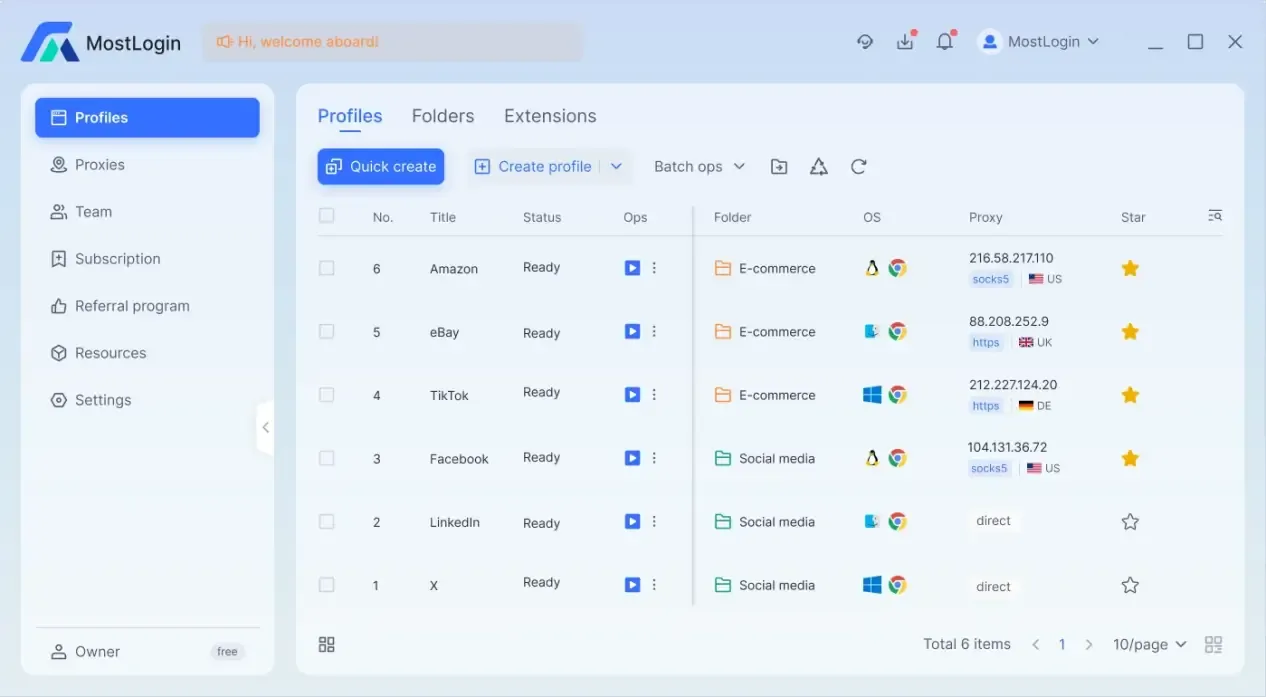
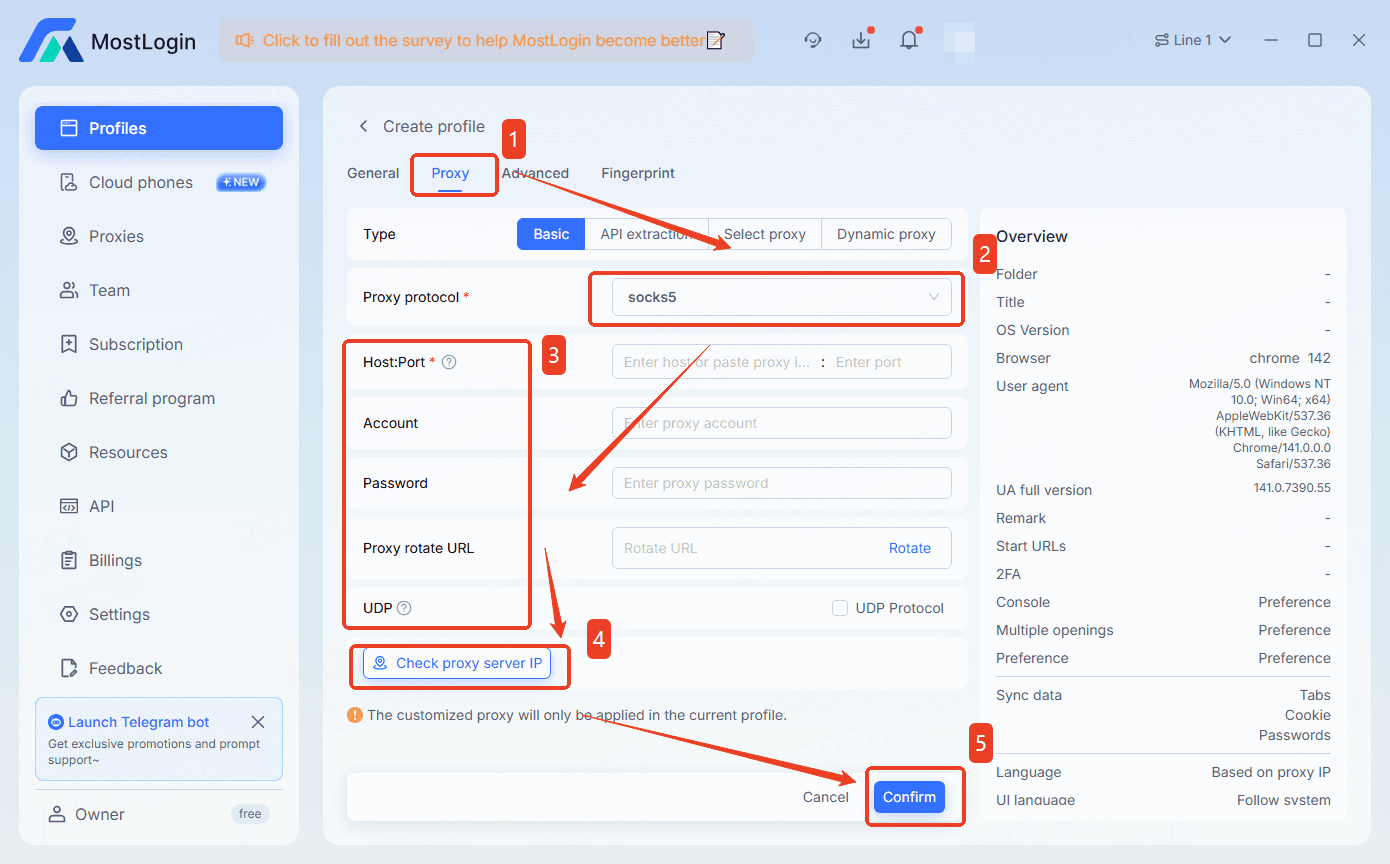
In addition to security protection, MostLogin Anti-Detection Browser can also realize quick launch of multiple windows/multiple accounts, which is simple and convenient while improving our efficiency. At present, MostLogin also has the "Forerunner Program", with anti-detection functions available according to the current plan and cloud phone services offered separately. Welcome to experience it.
FAQ
Why Are Newly Registered Affiliate Accounts Also Quickly Associated?
Platforms do not only look at the accounts themselves, but also comprehensively consider information such as device fingerprints, browser environments, IPs and behavior models. If these characteristics are highly similar to those of previously banned accounts, new accounts will also be quickly associated.
Can Simply Changing IP Avoid Account Association?
No. IP is only one of the association dimensions. If the browser fingerprint, device environment and operation behavior remain consistent, the platform can still judge account association through other signals.
Why Are Affiliate Marketing Accounts Prone to Collective Banning?
Platforms usually first identify the association relationship between accounts, and then impose penalties uniformly. Affiliate marketing accounts are highly similar to each other. Once one of them is determined to be in violation, its associated accounts will also be included in the risk pool.
What Are the Most Valued Association Signals by Platforms?
At present, the core ones include browser fingerprints, device environment consistency, IP type and stability, as well as long-term operation behavior models.
MostLogin Anti-Detection Browser helps users solve high-frequency problems such as multi-account operation, environment isolation and account risk control.
For operational questions, please refer to the Official Help Documentation