This article mainly analyzes with everyone why Google Ads accounts still get banned even after changing IP addresses in multi-account deployment, why Google has been frequently banning Ads accounts recently, as well as what we need to pay attention to and how to operate to avoid account suspension.
In recent years, many friends engaged in Google Ads multi-account deployment should have noticed that the official detection and ban efforts on accounts have increased significantly. Previously, we only needed to change IP addresses for multiple accounts to protect their security, but now this method is not only ineffective but also leads to multiple accounts being banned simultaneously.
Although the official has indeed indicated in previous updates that the detection mechanism has been updated, we still do not know the specific reasons why our accounts are still banned after changing IP addresses. Today, we will provide an in-depth explanation of the relevant content and solutions to help everyone better protect their Google Ads accounts.

Why Are Google Ads Accounts Getting Banned More Frequently Now?
The advertising ecosystem is evolving faster than ever, and Google Ads' control over fake accounts, non-compliant promotions, and multi-account marketing has become increasingly stringent. The risk control method that mainly relied on IP information in the early days is no longer as effective, so Google continuously updates its account detection mechanisms to prevent these issues.
In comparison, the current Google Ads risk control emphasizes adjustments and comprehensive judgments from multiple aspects, not just IP information. Therefore, simply adjusting IP-related settings is not very useful at present. We need to make adjustments or modifications from multiple angles to prevent the official from detecting that multiple accounts are controlled by the same person.
Why Do Google Ads Accounts Still Get Banned After Changing IP Addresses?
Google Ads now detects and analyzes from many aspects, not just IP addresses, so we need to consider more factors now. Below we will explain several common detection aspects at present:
1. IP Dimension Detection (The Most Basic)
IP is still part of the judgment factors, but now it mainly checks whether multiple Google Ads accounts log in with the same IP, whether the IP is abnormal, whether the account switches IP frequently, and whether the network to which the IP belongs is marked as high-risk. This is why many people used to change IP addresses to bypass detection in the early days.
At present, this detection method is relatively basic, so overall, this is the most basic requirement to meet.
2、Browser Fingerprint (Current Focus)
Currently, the most crucial and easily overlooked detection is browser fingerprinting. A browser fingerprint is not a single parameter but a set of multiple pieces of information, including: operating system type, browser version, User-Agent, Canvas fingerprint, WebGL information, font list, screen resolution, time zone and language, hardware-related parameters, etc. The combination of this information forms a relatively stable and hard-to-modify browser characteristic, which is the browser fingerprint.
With this detection method, even if we change the IP address, other information will still be linked to multiple accounts. After all, IP addresses are relatively easy to change, but hardware or other information is more troublesome or costly to replace. This is why many people still have multiple accounts banned even after changing IP addresses. If we want to operate for a long time, we need to achieve account anti-association operation.
3. Cookies and Local Data
In addition to fingerprints, browsers store a large amount of information and data, such as Cookies, LocalStorage, Session data, historical access records, login path information, etc. Although this data can be cleared, it cannot be completely isolated, so even if we clear the cache, it may not be completely cleaned up, resulting in high risks.
4. Identification of Behavioral Patterns and Operational Habits
Google Ads also uses behavioral models to determine whether accounts are associated, such as whether multiple accounts log in during similar time periods (e.g., one account logs in while another logs out), whether the operation rhythm is very similar, whether the ad structure is very similar, whether the deployment process is repeated, and whether the order of modifying settings is the same. Behavioral feature judgment is actually the most difficult one to handle. After all, the overall process is almost the same, and similarity is normal. The focus we need to pay attention to is not here, but more on other content.
5. The Device Has Had an Account Banned Before
If a device or environment has ever had an account banned or received other penalties, this device will most likely be marked. Therefore, new accounts we log in to in this environment later are also likely to be marked, which is extremely dangerous overall. This is also the reason why many new accounts do not last long after registration.
What Should We Pay Attention to for Continuing Google Ads Multi-Account Deployment?
At present, it is best for us to use an independent and real operating environment for each account, and it is best not to change the IP address. Specifically:
Use an independentbrowser environment for each account
Fingerprint parameters between multiple environments are distinguished from each other
Complete isolation of Cookies/local data
Bind a fixedproxy IP to each account
Avoid highly repetitive operational behaviors as much as possible
The essence of this method is not to bypass detection, but to make each account look like a real, independent user, making it less likely to be detected.
So How Should We Achieve These?
Directly replacing computers or devices is very troublesome, and using multiple computers for accounts in different regions is also very time-consuming and costly. Therefore, it is best for us to manage these on a single computer. In fact, we can use a well-known tool in this field to help us achieve this, which is the anti-detection browser.
A good anti-detection browser on the market is MostLogin Anti-Detection Browser. It has very powerful functions. It can not only open multiple windows on the same computer but also isolate these windows and set independent IP addresses for them, which is very convenient and easy to use.
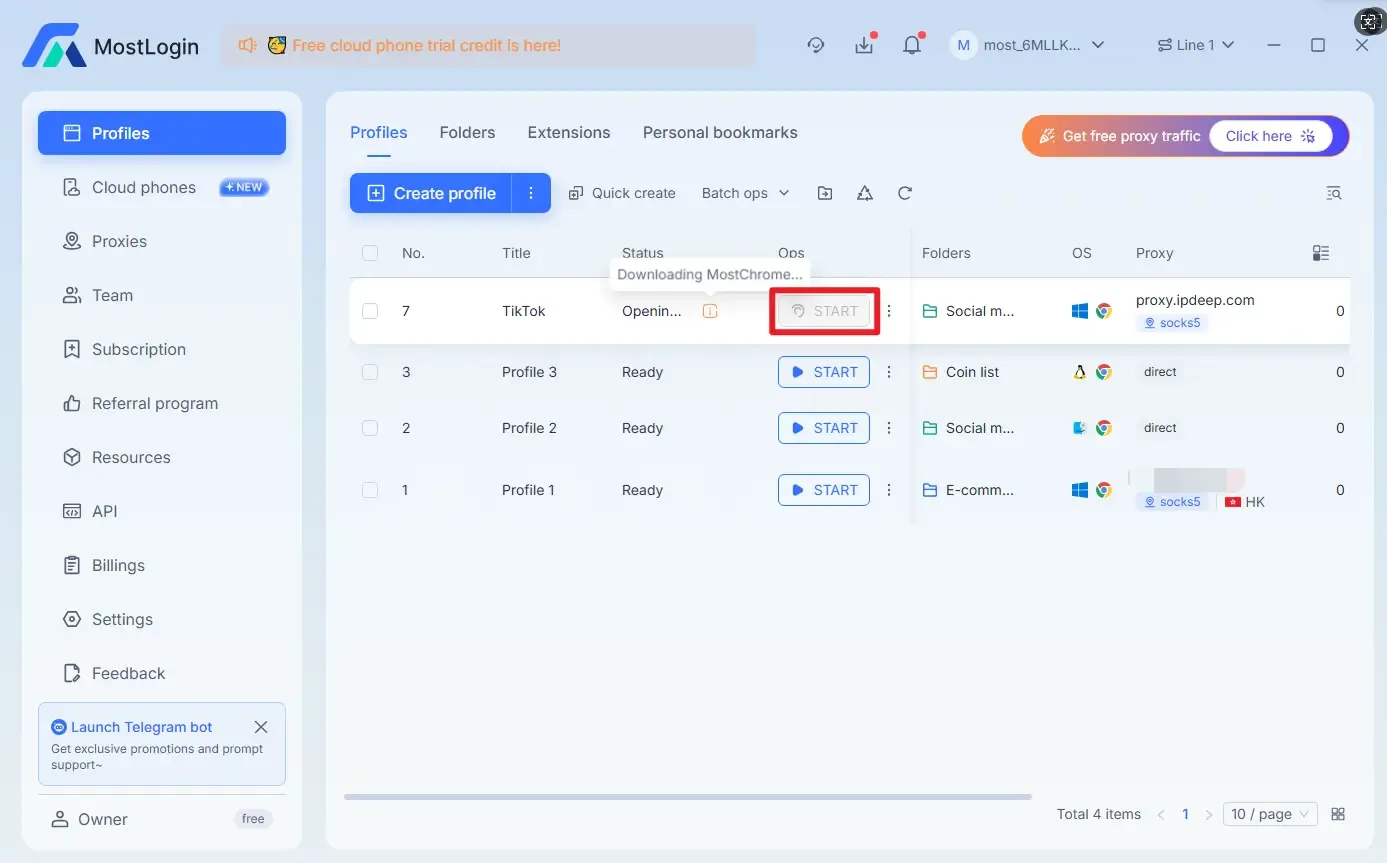
What Can MostLogin Anti-Detection Browser Help Us With?
MostLogin Anti-Detection Browser has comprehensive functions, such as the following:
Configurable and distinguishable fingerprint parameters
Create an independent browser environment for each account
Reduce the risk of association between accounts
Support binding with proxy IP addresses
Manage multiple accounts simultaneously without mutual influence
Complete isolation of Cookies and local data
Summary
In current Google Ads multi-account deployment, account bans are not just about IP issues; changing IP addresses too frequently in a short period may even lead to account bans more easily. Now Google pays more attention to device, fingerprint, and behavioral factors, so creating independent, stable, and isolated environments is the most important thing we need to do. If you also want to try to achieve these, welcome to use MostLogin Anti-Detection Browser to help you!
FAQs:
Can Incognito Mode Avoid Google Ads Account Association?
No. Incognito mode only does not save browsing history and some Cookies; it does not change browser fingerprints or device information, so it may still be identified as the same environment.
Can Multiple Google Ads Accounts Be Operated on One Computer Simultaneously?
It is possible but highly risky. Logging in to multiple accounts in the same browser or device environment is likely to be judged as associated accounts. However, you don't need to worry so much if you use an anti-detection browser.
Can a Computer with a Previously Banned Account Still Be Used?
There is a high risk. A marked device may have left historical records, making it easier for subsequent new accounts to trigger risk control.
Is Frequent IP Address Changing More Secure?
Not necessarily. Excessively frequent IP switching or poor-quality proxies may instead be identified as abnormal behavior. Stability is more important for IP addresses than frequent changes.
Why Do Some People Change IPs Without Issues While Others Get Banned Quickly?
Because risk control is a result of comprehensive judgment, related to device environment, operational habits, and historical records, not just IP addresses.
What Are the Most Common Mistakes Newcomers Make?
Common mistakes include only changing IP addresses, not isolating environments, frequently switching accounts, using low-quality proxies, and having overly similar operation methods for multiple accounts.
Best Anti-Detection Browser - MostLogin
MostLogin Anti-Detection Browser helps users solve high-frequency issues such as multi-account operation, environment isolation, and account risk control.
For operational questions, please refer to the Official Help Documentation