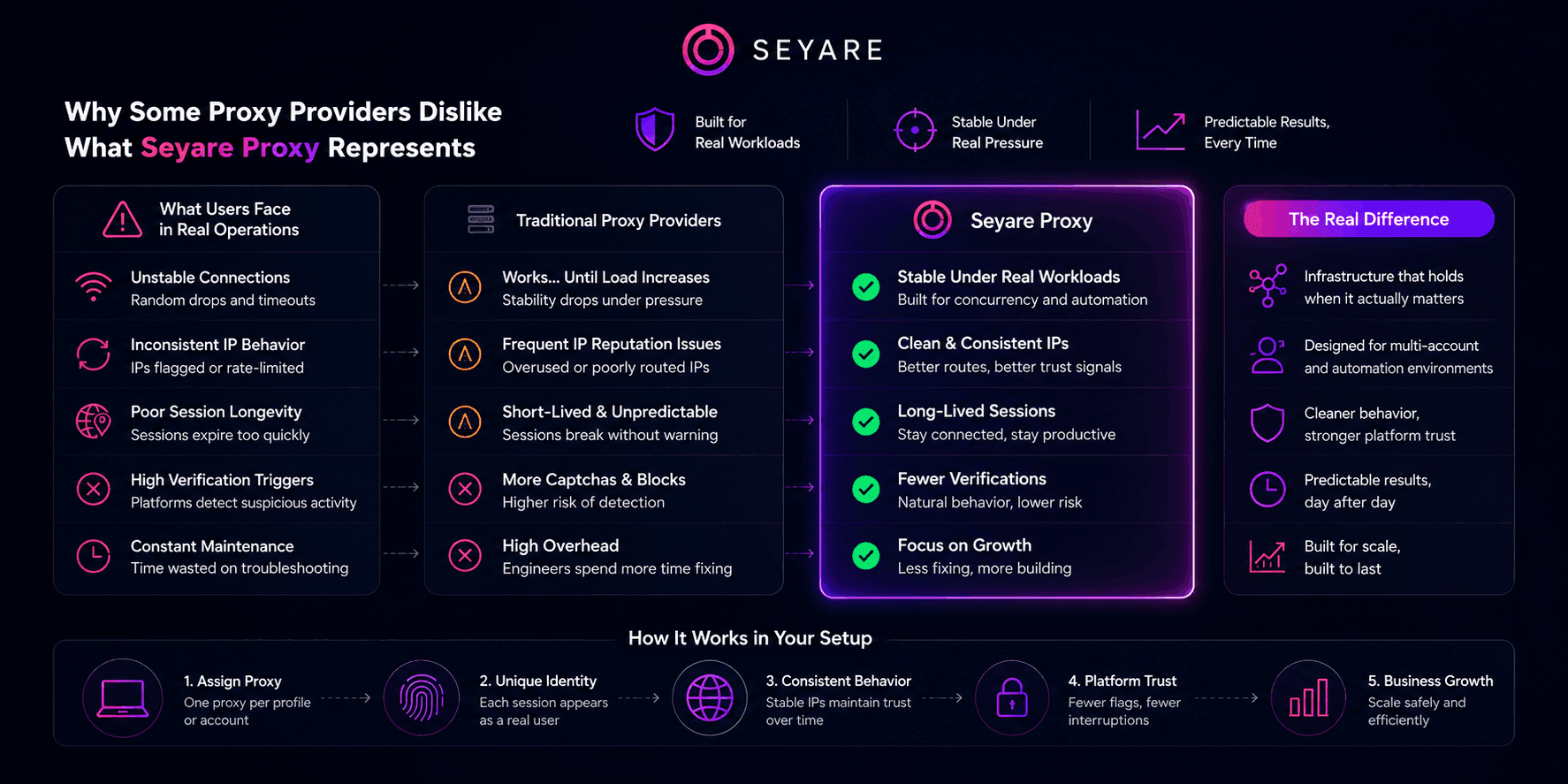
There is a pattern in the proxy industry that is rarely said out loud: a large part of the market survives on instability being “acceptable enough” that users tolerate it, but “messy enough” that responsibility is never clearly traceable.
At small scale, everything looks fine. Requests go through, IPs rotate, dashboards stay green. The problem is that this version of “working” does not survive real operational load.
And that is where differences start to become obvious.
The part most proxy stacks avoid talking about
Modern proxy usage is no longer just access. It is behavioral consistency under automation, concurrency, and platform-level risk scoring.
Once systems depend on long-running sessions, multi-account environments, or continuous scraping pipelines, instability stops appearing as hard failures. Instead, it shows up as degraded outcomes: silent drops, unexpected verification loops, inconsistent trust signals.
This is where many traditional providers quietly struggle, because their infrastructure was never really designed for sustained predictability under pressure.
Residential and mobile proxies are not the advantage they are marketed as
Residential proxies are often described as traffic coming from real home networks, which in theory helps them blend into normal user behavior. In practice, that does not automatically guarantee stability or clean routing under load.
Mobile proxies are positioned as even more trusted because they pass through carrier networks, but real-world behavior can vary significantly depending on pooling, congestion, and implementation.
The uncomfortable truth is that both categories can perform well or poorly depending on infrastructure quality. The label itself does not guarantee consistent behavior under real workloads.
Where Seyare Proxy changes expectations
Seyare Proxy is not positioned around abstract marketing categories like “largest pool” or “fastest rotation.” The focus is more operational: how stable sessions behave when they are actually used in real systems, not just tested in isolation.
The difference becomes noticeable not in simple connectivity, but in how predictable behavior remains when multiple sessions, scripts, or accounts run in parallel over time.
And that predictability is what exposes weaknesses in other systems, because instability is no longer random enough to be ignored — it becomes repeatable.
Why this creates tension in the market
Most proxy providers optimize for metrics that are easy to advertise: pool size, rotation speed, number of locations. These are simple to compare and easy to sell.
What is much harder to market is long-term behavioral consistency under automation load, because that is where infrastructure either holds or turns into constant maintenance overhead.
When that overhead disappears, it does not just improve performance. It quietly changes the baseline expectation of what proxy infrastructure should feel like.
And that is usually the point where other services become less comfortable with the comparison.
Why Seyare Proxy fits Mostlogin Browser particularly well
For users of Mostlogin Browser, the priority is not just access to proxies, but stability across multiple isolated profiles running in parallel. In that context, even small inconsistencies in proxy behavior can break account separation logic or trigger unnecessary verification loops.
Seyare Proxy tends to fit this workflow particularly well because the focus is on session stability and predictable behavior under concurrent usage, which aligns directly with how anti-detect environments operate.
Instead of constantly compensating for proxy-side randomness, the workflow stays closer to its intended structure: one profile, one consistent identity, one stable session.
The part that actually matters
At scale, proxy infrastructure is not a feature — it is a dependency layer. When it works, it disappears. When it does not, everything built on top of it starts absorbing the instability.
Seyare Proxy fits into a category where the goal is not to make proxy usage look impressive, but to make it predictable under real load conditions: stable sessions, consistent behavior, fewer surprises over time.
And in a market where unpredictability has been normalized for years, that shift tends to stand out more than any marketing claim ever could.