TikTok has become one of the most powerful platforms for content creators, marketers, and businesses. With over a billion monthly active users and an algorithm that can take an unknown account to millions of views overnight, the commercial opportunity is unlike anything else in social media. Naturally, serious operators — agencies managing multiple clients, brands running regional presences, and marketers testing parallel content strategies — find themselves needing to run more than one TikTok account simultaneously.
The challenge is significant. TikTok's detection systems in 2026 are among the most aggressive of any social platform, shaped partly by the intense regulatory scrutiny the app has faced in Western markets and partly by ByteDance's investment in platform integrity infrastructure. What worked two years ago — basic VPN switching, browser incognito mode, a second phone — reliably fails today.
This guide covers TikTok's platform policies, why multi-account operations make sense for legitimate professional use cases, and how to build the technical infrastructure that actually holds up in 2026. That means MostLogin's antidetect browser and cloud phone technology, paired with quality proxies from Thordata, and the operational discipline that keeps accounts running long-term.
Understanding TikTok's Platform Policy on Multiple Accounts
Before building any infrastructure, it is worth understanding what TikTok actually prohibits — and what it does not.
What TikTok's Terms Actually Say
TikTok does not explicitly forbid having multiple accounts. The platform supports personal accounts, creator accounts, business accounts, and TikTok Shop seller accounts coexisting. Many legitimate users maintain more than one account for different purposes — a personal account and a brand account, for example, or separate accounts for different creative niches.
What TikTok's Community Guidelines and Terms of Service prohibit is coordinated inauthentic behaviour: operating networks of accounts to artificially amplify content, using automation to simulate engagement, creating accounts specifically to evade previous bans, and operating fake personas that misrepresent who is behind an account.
The practical implication is that the question is not whether you have multiple accounts — it is whether those accounts appear to TikTok's detection systems as separate, independent, genuine users. That is an entirely solvable technical problem.
What TikTok's Detection Systems Monitor
TikTok's detection infrastructure works across several signal layers simultaneously. Understanding each one shapes how you build your setup.
Device fingerprinting. TikTok's mobile app collects extensive device telemetry when you log in. On Android, this includes device model, manufacturer, build fingerprint, Android ID, network operator, and hardware parameters. On the web version, it covers canvas rendering signatures, WebGL identifiers, screen dimensions, navigator properties, and installed font characteristics. The same device fingerprint appearing across multiple accounts is one of the most reliable signals that those accounts share an operator.
IP address reputation and consistency. TikTok maintains IP reputation databases and monitors login patterns at the network level. Multiple accounts connecting from the same IP address — especially in quick succession — is a direct trigger for account linking. IP addresses associated with known VPN providers, datacenter ranges, or previously flagged activity carry reduced trust scores from the moment of first contact.
Behavioural pattern analysis. TikTok's algorithm is calibrated around mobile-native user behaviour. Accounts that post at exact intervals, follow the same number of accounts every day, or produce engagement patterns with robotic regularity look different from genuine users regardless of how clean the underlying technical environment is.
Content fingerprinting. TikTok fingerprints video content at the file level. Posting the same video across multiple accounts — even with minor edits, different aspect ratios, or re-encoded files — is detected. The platform cross-references content signatures across its account graph, and duplicate content is a reliable signal of coordinated operation.
Account relationship graphs. TikTok builds relationship maps across its platform. Accounts that consistently engage with the same set of third-party profiles, follow each other, or interact with the same content in tight time windows can be linked through graph analysis even when their technical environments appear separate.
Common Ban Triggers
Understanding specific triggers helps you design around them:
- Same device fingerprint across accounts. Whether on mobile or web, the same device identity appearing behind multiple accounts is the most common source of chain bans — where one account is flagged and TikTok uses the shared fingerprint to identify and restrict the others.
- Shared IP addresses. Multiple accounts logging in from the same IP, especially within the same session or same day, creates an immediate network-level link.
- VPN traffic patterns. TikTok is notably more aggressive at identifying VPN traffic than most other platforms. Standard VPN protocols — including many obfuscated options — are detectable through traffic pattern analysis, and VPN IP ranges are flagged at the ASN level.
- Duplicate content. Posting the same video across multiple accounts is one of the fastest ban triggers. TikTok's content fingerprinting catches re-encodes that would pass undetected on other platforms.
- Robotic action patterns. Posting at exactly the same time every day, following exactly the same number of accounts per session, or engaging with content in perfectly uniform intervals flags behavioural analysis regardless of technical isolation.
- New account over-acceleration. New TikTok accounts have significantly lower trust scores than established ones. Running them at full activity velocity from day one reliably triggers early restrictions.
Why Adopt a Multi-Account Strategy?
Despite the detection challenges, multi-account operations are standard professional practice for a range of entirely legitimate use cases.
1. Agency Client Management
Social media agencies managing TikTok for multiple clients need genuinely separate account environments per client. Clean analytics, isolated brand voices, different posting schedules, and separate team access requirements all demand proper account separation. Running client accounts in a shared environment creates operational and reputational risk.
2. Niche and Audience Segmentation
A single brand often addresses multiple genuinely distinct audiences that respond to different content styles. A consumer brand might maintain separate accounts for product education, lifestyle content, regional markets, and promotional campaigns. Each account develops its own algorithmic momentum rather than fighting internal audience conflicts.
3. Geographic Market Expansion
TikTok's content distribution is heavily geography-weighted. Brands expanding into new markets benefit from localized accounts that use regional sounds and trends, post during local peak hours, operate with locally consistent IP addresses, and build algorithmic trust within the target region's content graph.
4. Content Testing and Optimisation
Running parallel accounts lets you systematically test content formats, posting cadences, hook strategies, and audience targeting approaches. The learnings from controlled tests on lower-priority accounts inform strategy on primary accounts — without risking the algorithmic standing of your main presence.
5. Risk Distribution
A temporary restriction or shadowban on one account does not disrupt your entire TikTok operation if accounts are genuinely isolated. Redundancy is a basic operational principle, and it is especially valuable on a platform where algorithmic standing can shift quickly.
6. TikTok Shop and E-commerce Operations
TikTok Shop sellers operating multiple storefronts or product lines benefit from separate account presences that maintain distinct identities for different product categories or regional markets, each with its own audience base and content history.
The Solution: MostLogin Antidetect Browser and Cloud Phone
Managing multiple TikTok accounts without bans requires solving the detection problem at its root — which means genuine device and network isolation for each account, not workarounds that platform detection systems have already learned to identify.
MostLogin (available at mostlogin.com) addresses this through two complementary technologies: an antidetect browser for desktop-based account management and cloud phone technology for mobile-native access.
What Is an Antidetect Browser?
An antidetect browser creates fully isolated browsing environments where each profile appears to TikTok as a completely separate device. Unlike incognito windows (which share the same browser fingerprint) or different browser applications (which share the same system-level identifiers), each MostLogin profile maintains completely independent:
- Canvas and WebGL fingerprints: Unique rendering signatures generated per profile, each appearing as a distinct device to TikTok's identification systems
- Navigator properties: Hardware concurrency, device memory, platform, and language settings configured to match the profile's target geography
- Screen resolution, color depth, and device pixel ratio: Consistent per profile and calibrated to realistic device specifications
- Cookie store and local storage: Completely isolated per profile with zero data shared between profiles, even when multiple profiles are open simultaneously
- Proxy assignment: Each profile routes through its own dedicated IP address, meaning each account connects from a distinct network identity
The result is that TikTok's detection systems cannot distinguish a MostLogin profile from a genuinely separate device operated by a genuinely separate user.
What Is Cloud Phone Technology?
TikTok is fundamentally a mobile-first platform, and its detection systems are calibrated around mobile app behaviour. The TikTok mobile app submits far more device telemetry than the web version, and the platform's trust systems reward mobile-native usage patterns. This is where cloud phone technology becomes important.
MostLogin's cloud phone solution provides virtual Android environments running in the cloud. Each instance is a real Android environment — not a simulated one — with unique device identifiers including IMEI, Android ID, and hardware parameters. Each cloud phone operates on its own network connection and supports the full TikTok mobile app experience, including features that are not available on the web version.
For accounts where authenticity and algorithmic performance matter most, cloud phones provide a level of mobile-native trust that desktop browser sessions cannot replicate.
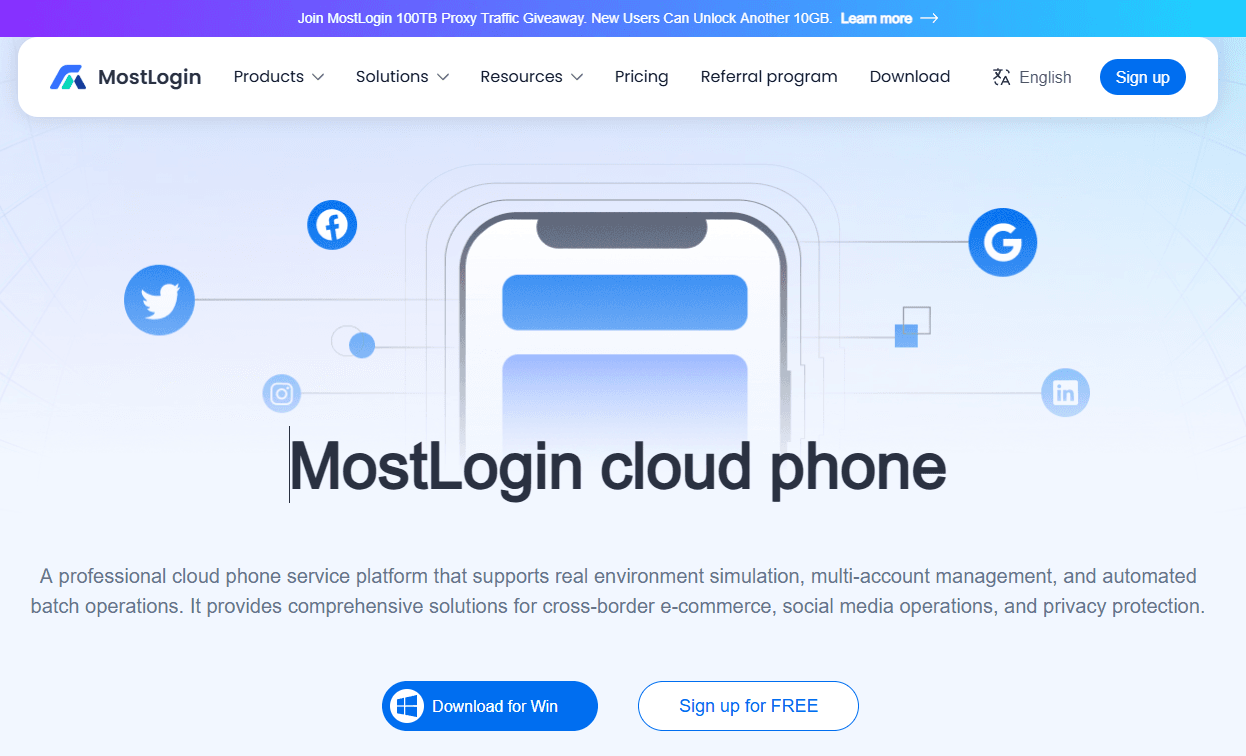
When to Use Antidetect Browser vs. Cloud Phone
Choosing between these two approaches — or using both — depends on what you are trying to accomplish with each account.
Use Antidetect Browser When:
Managing desktop-based operations efficiently. Content scheduling, analytics review, comment management, and account administration are all faster and more comfortable on a desktop interface. If your workflow is primarily administrative rather than content-creation focused, an antidetect browser handles everything you need.
Budget-conscious scaling. Antidetect browsers have a lower per-account cost than cloud phone instances. For operations running 5–25 accounts where mobile-exclusive TikTok features are not required, the antidetect browser is the more cost-effective infrastructure choice.
Team collaboration at scale. MostLogin's role-based access system allows multiple team members to access assigned account profiles with appropriate permissions. Operation logs track every action across the account pool, which is essential for agency environments where accountability and client reporting matter.
Content upload and engagement management. Pre-edited videos upload cleanly through the browser interface, and TikTok's web version supports most standard engagement activities. For accounts where content is produced externally and managed administratively, browser-based access is entirely sufficient.
Use Cloud Phone When:
Mobile-first content creation is the priority. TikTok's algorithm measurably favours content created and posted natively through the mobile app. For accounts where algorithmic reach is the primary goal, cloud phones provide a more authentic content-creation signature that correlates with better initial distribution.
Access to mobile-exclusive features is required. Live streaming on TikTok requires the mobile app. Certain Reels effects, sounds, and interactive features are only accessible through mobile. TikTok Shop management and certain in-app commerce features require mobile access. For accounts using these capabilities, cloud phones are the only option that provides genuine mobile-app functionality.
Maximum isolation for high-value accounts. Cloud phones provide the deepest available level of device isolation — genuine Android telemetry, real device identifiers, and mobile carrier network traffic. For accounts that represent significant investment or ongoing revenue, the higher isolation ceiling justifies the additional cost.
Large-scale operations running continuously. For operations managing 30 or more accounts with sustained daily activity, cloud phones running consistent schedules are more manageable than orchestrating that volume through browser profiles. The ability to set and maintain persistent activity patterns 24/7 without manual session management is a meaningful operational advantage at that scale.
Hybrid Approach
Professional multi-account operators typically combine both technologies:
- Cloud phones for primary content creation, live sessions, and engagement on high-value or high-activity accounts
- Antidetect browser for analytics, scheduling, lower-priority account management, and backup access
- Each environment supported by dedicated proxies from a reliable provider
This approach optimises cost against capability — investing cloud phone resources where they deliver the most value, and using browser profiles where the use case does not require mobile-native authentication.
Integrating ThorData Proxies for Complete Account Isolation
Device isolation through MostLogin addresses the fingerprint layer of TikTok's detection system. The network layer — your IP address — requires equally careful attention. Every account in your operation needs a dedicated, clean IP address that is consistent across sessions and does not appear in TikTok's flagged IP databases.
This is where Thordata (thordata.com) comes in.
Why Proxy Quality Matters for TikTok
TikTok's IP detection is more aggressive than most other platforms. Standard VPN exit nodes are flagged at the ASN level. Datacenter IP ranges are identified immediately. Even lower-quality residential proxy pools that have been abused by other users carry reputation damage that triggers elevated scrutiny on new accounts.
TikTok's algorithm also monitors IP consistency. An account that connects from a different IP every session — as happens with rotating residential proxy pools — looks different from a genuine user who consistently connects from the same home or mobile connection. Sticky sessions that maintain the same IP across multiple login events are essential.
Choosing the Right Proxy Type
Residential proxies appear to TikTok as genuine home internet connections. They carry the highest trust score of any proxy type for desktop-based account management and are the standard choice for antidetect browser profiles managing TikTok accounts.
Mobile proxies route through real 4G/5G carrier networks, placing them at the same trust tier as genuine mobile users. They are the best match for cloud phone setups — the proxy's mobile carrier origin reinforces the mobile device telemetry being submitted by the virtual Android environment. TikTok's detection systems are less likely to flag activity that presents a fully consistent mobile identity at both the device and network layers.
Datacenter proxies are not appropriate for TikTok account management. TikTok's IP reputation systems are well-calibrated against datacenter ranges, and using them for active account operations is a reliable path to restrictions. They are only suitable for read-only data collection and competitive research where no account login is involved.
Setting Up Thordata Proxies with MostLogin
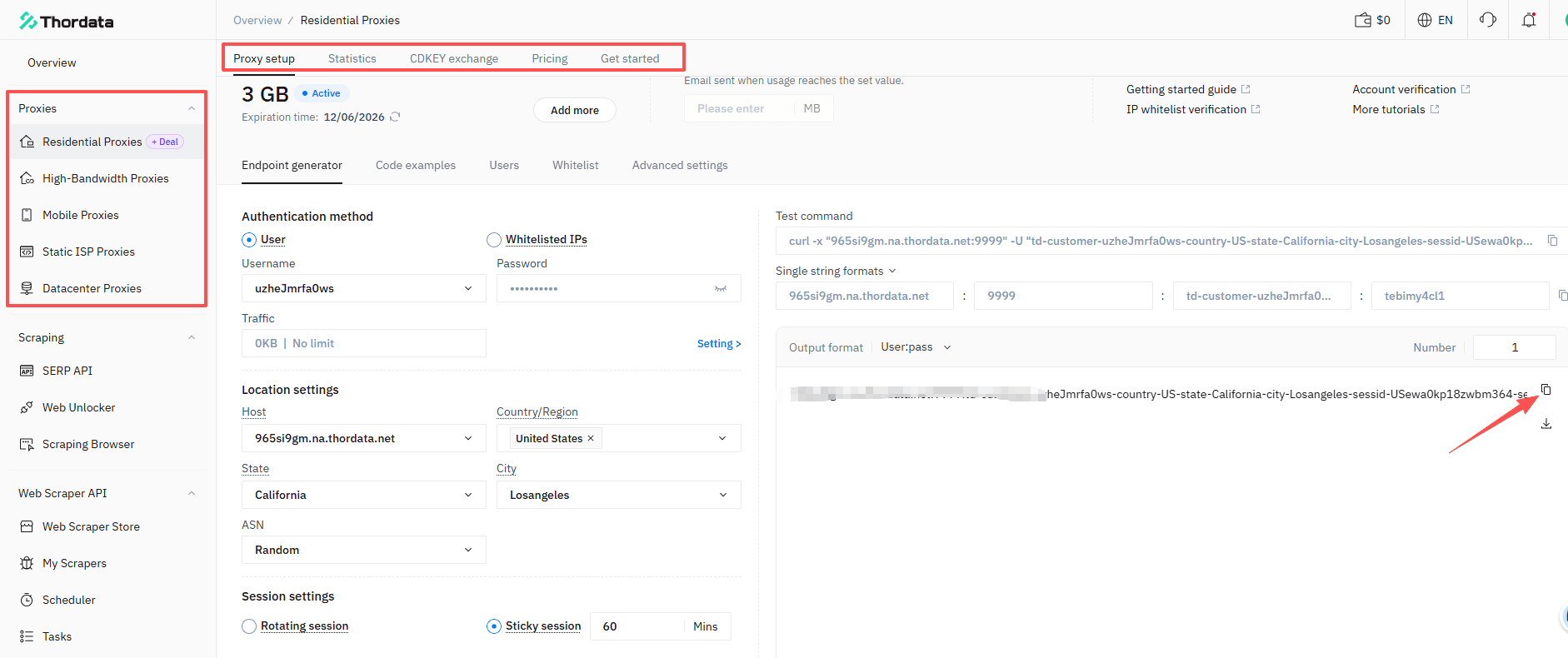
For antidetect browser profiles:
Visit thordata.com and select residential proxies with sticky session support. Configure the proxy for your target geographic location — the country and ideally the city should match the account's target audience and the browser profile's timezone and locale settings. Generate the proxy and copy it.
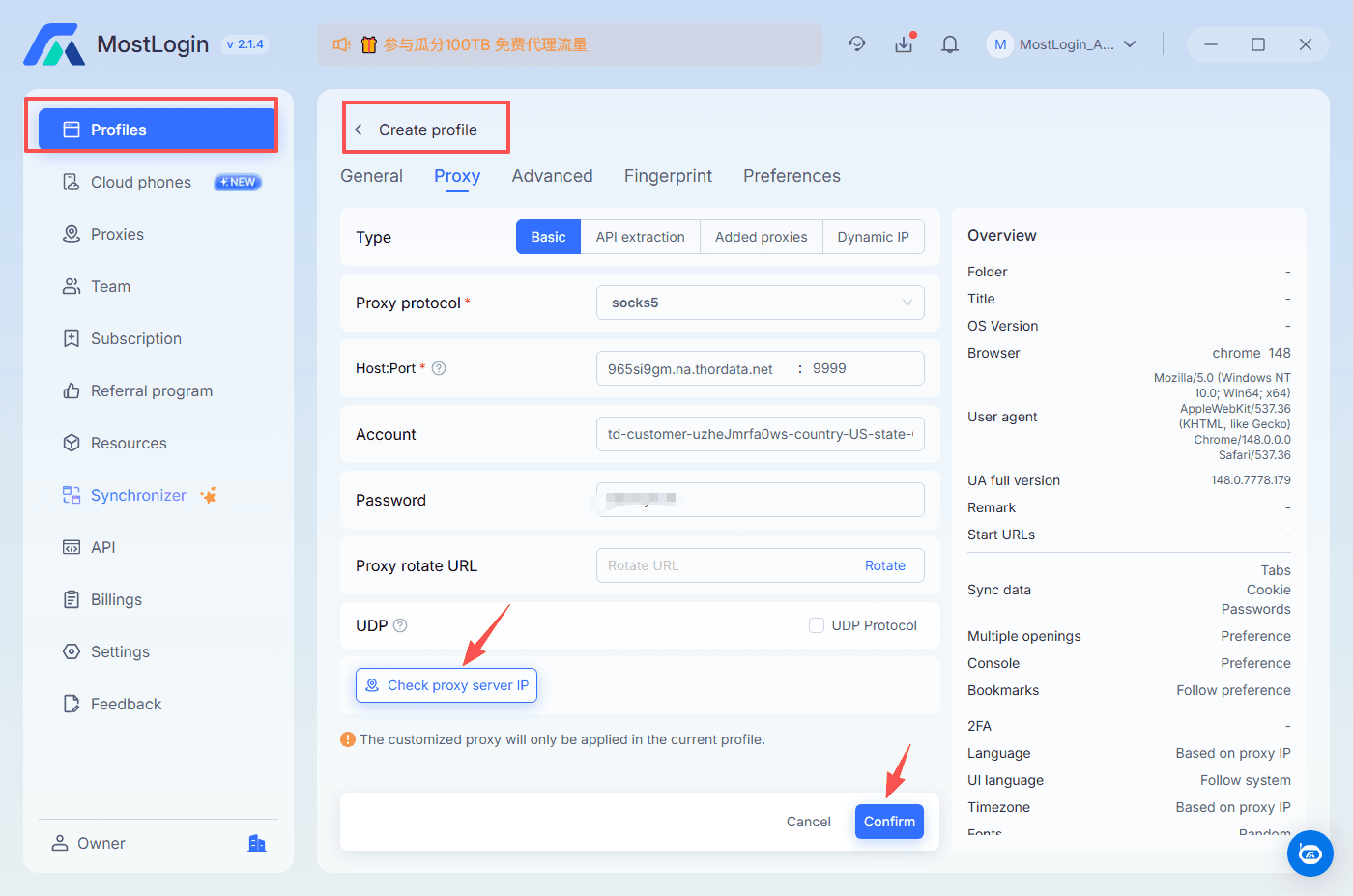
Download and sign-in to MostLogin, create a new browser profile and navigate to the proxy configuration section. Enter your Thordata credentials including host, port, username, and password. Test the connection to confirm the IP assignment, then verify that the reported location matches your configured settings, or just automatically match the timezone & location based on IP proxy. Save the profile and use it exclusively for the account it was created for.
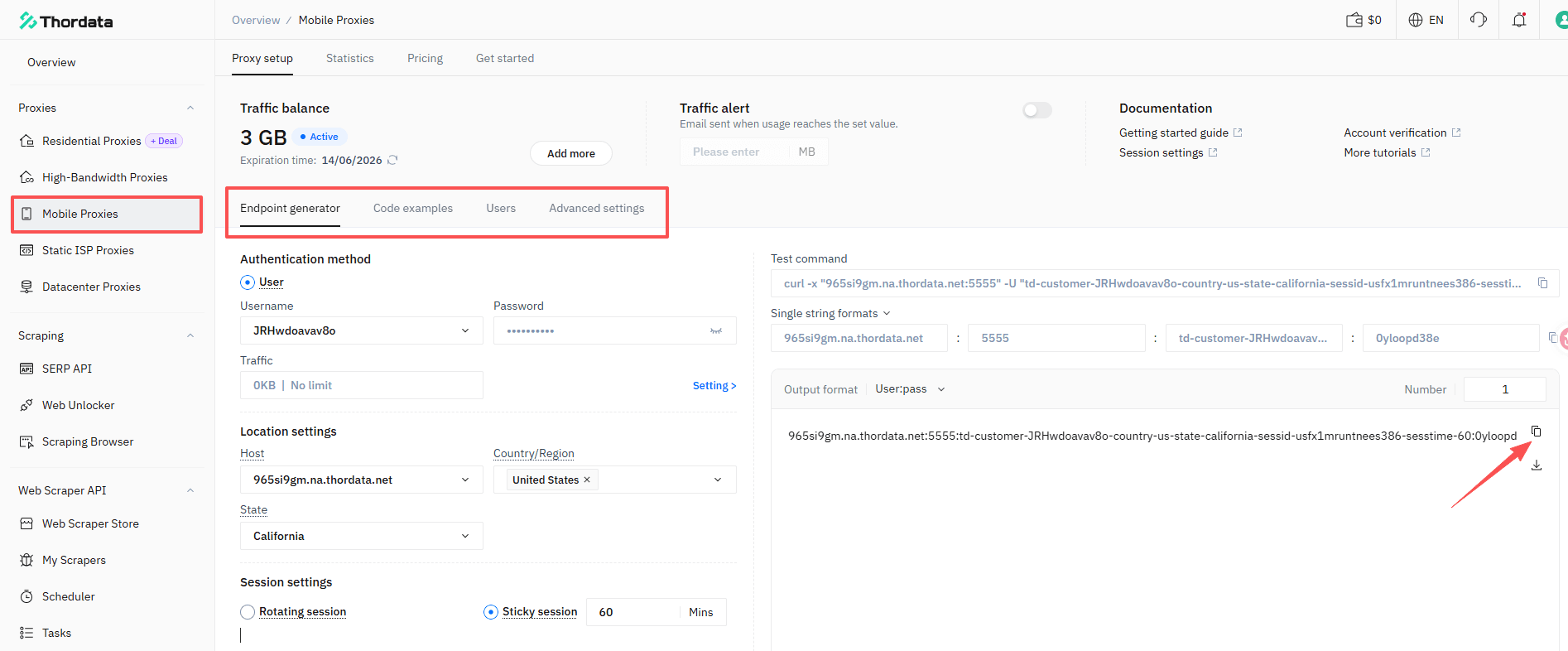
For cloud phone instances:
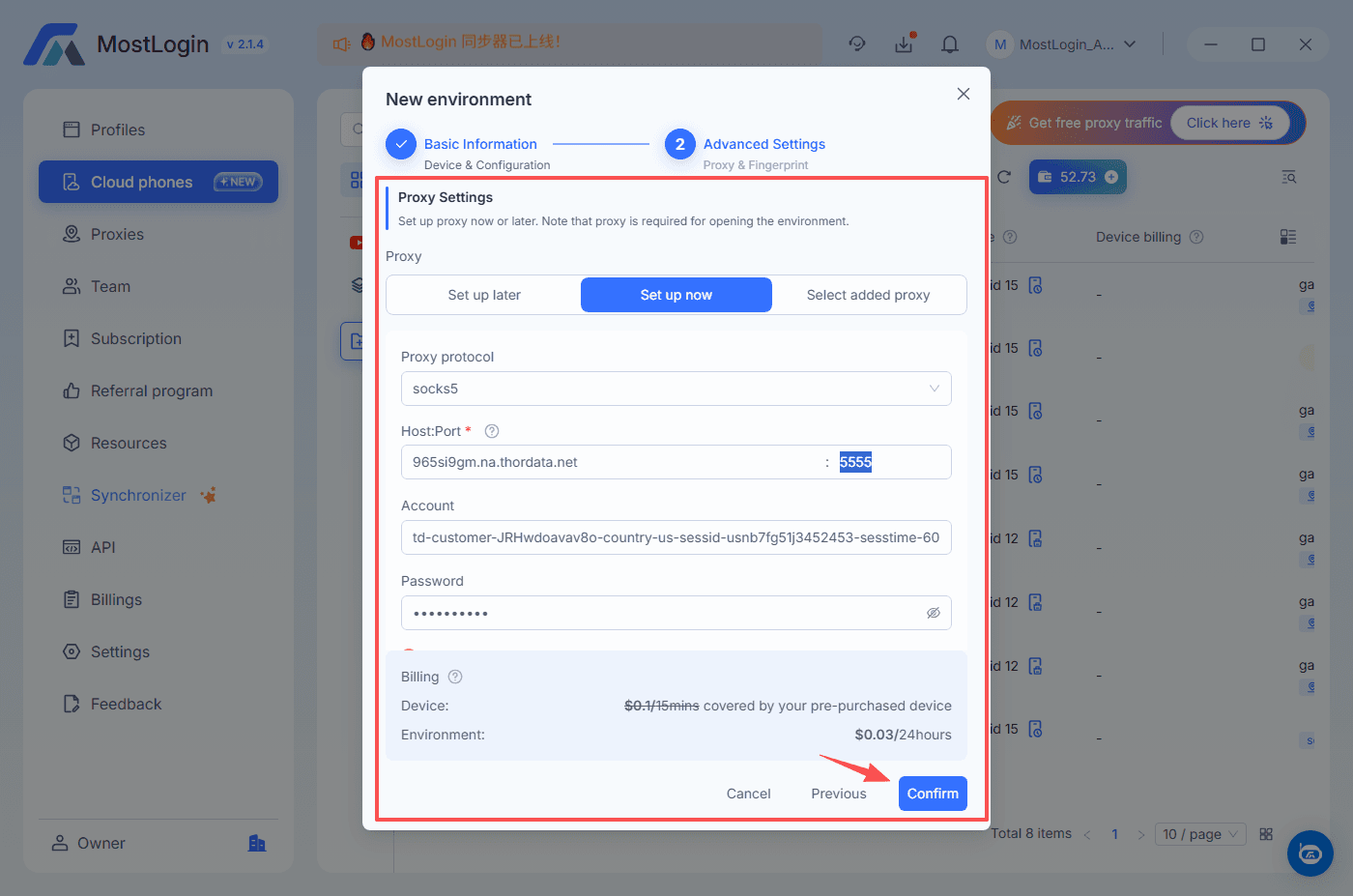
Select mobile proxies from Thordata matching your cloud phone's target region. Lock network settings to prevent accidental changes during active sessions. Generate the mobile proxy and easily copy it.
Login to the MostLogin desktop client and navigate to Cloud phone. Create a new environment by hitting the “New evn” button. Purchase an owned device based on your business needs.
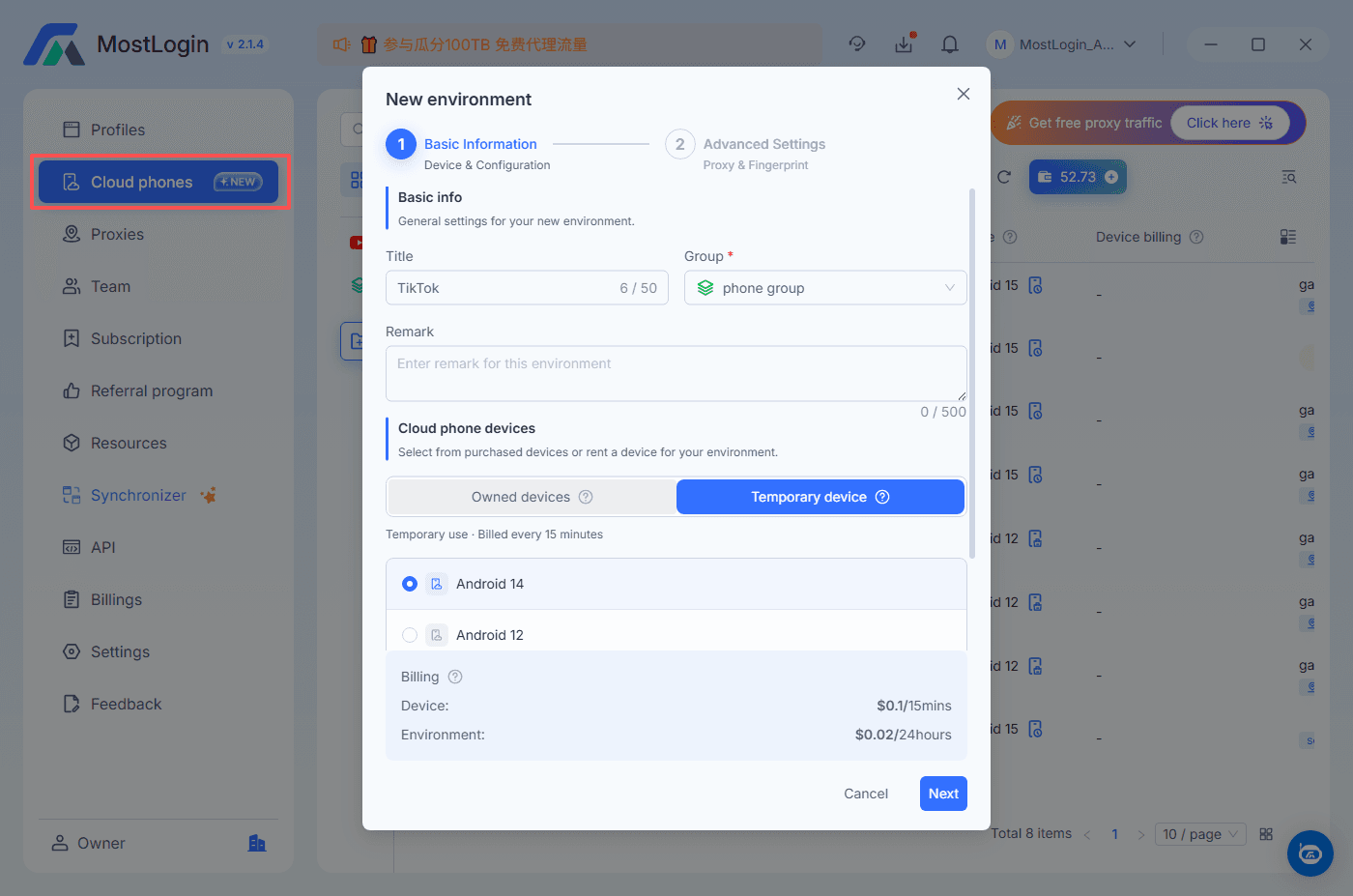
Paste the mobile proxy you copied from Thordata in the proxy setting. Hit confirm to save the proxy. Then use the MostLogin cloud phone to login to your TikTok accounts and operate them.
Proxy Hygiene Tips
- Assign one dedicated proxy per TikTok account. Never share a proxy between two accounts.
- Use sticky sessions exclusively. The same account connecting from a different IP each session is a detectable pattern.
- Monitor proxy health actively. A proxy that drops connection mid-session can expose your real IP, which links that session to your actual location.
- Maintain geographic consistency. Do not switch an account from a US proxy to a UK proxy without treating it as a location change — reduce activity for several days afterward to avoid impossible-travel flags.
- Rotate proxies periodically (every 60–90 days) but treat each rotation as a location-change event rather than a seamless transition.
Best Practices for Multi-Account TikTok Management
Technical infrastructure creates the conditions for safe operation. Operational discipline is what keeps accounts running.
1. Build Genuine Account Identities
Each account should have a coherent identity that makes sense as a standalone TikTok presence. Distinct profile pictures, bios that reflect the account's specific focus, a consistent content style, and an engagement pattern appropriate to the account's niche. Accounts that look like they were assembled from a template attract algorithmic review even when the technical environment is clean.
2. Warm Up New Accounts Properly
New accounts have substantially lower trust scores than established ones. The warming schedule matters:
- Days 1–7: Browse the For You page, watch videos, like a small number of posts (10–15 maximum). No posting, no following.
- Days 8–14: Begin posting once every 2–3 days. Follow 10–20 accounts in the target niche. Continue light engagement.
- Days 15–21: Post 3–4 times per week. Follow 20–30 accounts per day. Add occasional comments, varying in length and content.
- Days 22–30: Gradually approach normal operating limits. Never accelerate by more than 20–30% per week.
Running a new account at full velocity from day one is the most consistent cause of early restrictions. The warming period is not optional.
3. Stagger Activity Across Accounts
Never operate all accounts at peak activity simultaneously. Stagger posting times by at least 30–60 minutes across accounts. Vary daily active windows so accounts are not all running in the same time block every day. Include genuine rest periods where accounts are inactive. Vary action counts from session to session rather than hitting identical numbers every day.
4. Maintain Strict Content Uniqueness
TikTok's content fingerprinting is more thorough than most platforms. Every video posted across multiple accounts must be genuinely distinct — not just re-encoded or cropped differently, but actually different content. Use different background music, different visual framing, different caption styles, and different on-screen text. Never post the same trending audio across multiple accounts simultaneously, as this creates a detectable coordination signal.
5. Never Cross-Pollinate Account Graphs
The accounts you manage should never follow each other, like each other's content, or comment on each other's posts. TikTok's coordinated behaviour detection is specifically calibrated to catch this pattern. Extend the discipline to indirect cross-pollination: managed accounts should not engage with the same obscure third-party content in tight time windows.
6. Monitor Account Health Continuously
Watch for early warning signs of detection:
- Sudden drops in For You page views without a change in posting behaviour (possible shadowban)
- Videos entering extended "under review" status
- Follow or like actions receiving error responses
- Verification prompts appearing more frequently than expected
If you detect these signals, reduce activity on the affected account immediately, switch to passive browsing for 48–72 hours, and review recent actions for patterns that might have triggered detection. Early response to warning signs is far less costly than waiting for a full ban.
7. Secure the Operation
Use unique, strong passwords for every account. Enable two-factor authentication where available. Keep MostLogin and all related software updated. Maintain a clear mapping of which proxy is assigned to which account — a simple spreadsheet prevents the kind of accidental proxy swap that can link previously isolated accounts.
Common Mistakes to Avoid
Using free or shared proxies. Free proxies are shared among large numbers of users, frequently blacklisted by TikTok, and offer no session persistence. They introduce the IP reputation problems you are trying to avoid.
Logging into multiple accounts sequentially in the same session. Even with different credentials, sequential logins in the same browser session carry forward fingerprint and session data. Each account needs its own isolated profile, opened independently.
Ignoring timezone and locale settings. A profile whose IP says the United States but whose browser timezone is set to UTC+8 is a detectable mismatch. Every profile's geographic settings must match its proxy's location.
Duplicate content across accounts. Identical videos, near-identical captions, or copy-pasted comments across multiple accounts create content-level fingerprints that TikTok's detection system flags as coordinated activity.
Scaling before the system is validated. Starting with 30 accounts before you have confirmed that your setup works reliably at 5 is how most operations fail. The problems that appear at small scale are far easier to diagnose and fix than the same problems multiplied across a large account pool.
Over-relying on web interfaces for TikTok. TikTok is a mobile-first platform and accounts operated exclusively through desktop browsers carry a different behavioural signature from the majority of genuine users. For high-value accounts, supplementing browser management with cloud phone access is worth the additional cost.
Cost-Benefit Analysis
Understanding the investment required helps calibrate expectations.
Small Operation (5–10 Accounts)
- Thordata residential proxies (5–10 IPs): $10–80 / month
- Total: $30–80 / month
Medium Operation (10–30 Accounts)
- MostLogin antidetect browser and cloud phones: $100–400 / month
- Thordata residential and mobile proxies: $80–250 / month
- Total: $180–650 / month
Large Operation (30+ Accounts)
- MostLogin cloud phones and browser combined: $400–1,000+ / month
- Thordata premium residential and mobile proxies: $250–600+ / month
- Total: $650–1,600+ / month
Against the revenue from a professionally managed TikTok portfolio — creator fund income, brand partnerships, affiliate commissions, TikTok Shop sales — the infrastructure cost is modest. A single well-managed client TikTok account at agency rates commonly exceeds the monthly infrastructure cost of a small operation.
Legal and Ethical Considerations
Managing multiple TikTok accounts professionally is legitimate work. The ethical obligations are clear:
Represent clients and brands honestly. Do not use multi-account infrastructure to artificially inflate engagement metrics or create false impressions of organic reach. Follow FTC and relevant advertising disclosure guidelines across every account in your operation. Do not use accounts to coordinate harassment, mass-report competitors, or manipulate platform-level trends through inauthentic coordination.
Operations built on genuine content and real audience relationships are also substantially more resilient to platform detection than operations built primarily on volume and automation. The most durable multi-account operations are ones where each account is delivering genuine value to a genuine audience — the technical infrastructure exists to support that goal, not replace it.
Future-Proofing Your Strategy
TikTok's detection capabilities will continue to develop. A few principles that apply regardless of what specific changes the platform makes:
Keep your tooling current. MostLogin's regular browser engine and cloud phone updates are specifically designed to maintain detection resistance as TikTok deploys new identification techniques. Running outdated versions is the fastest way to see detection rates increase.
Invest in content quality. Accounts with genuine engagement histories and real follower relationships are significantly more resilient to platform scrutiny than accounts that exist primarily as technical infrastructure. Building real audiences is not at odds with running a multi-account operation — it is the foundation that makes the operation durable over time.
Diversify across platforms. The same infrastructure and operational disciplines that work for TikTok apply directly to Instagram Reels, YouTube Shorts, and other short-form video platforms. A multi-platform operation distributes risk and expands the total opportunity.
Scale methodically. Validate each expansion at small scale before broadening it. The incremental cost of careful testing is always smaller than the cost of discovering a systemic problem after full deployment.
Conclusion
Managing multiple TikTok accounts without bans in 2026 is entirely achievable — but it requires treating it as infrastructure work, not a shortcut. TikTok's detection systems are genuinely sophisticated and improve continuously. The operations that hold up over time are the ones built on genuine technical isolation, careful operational discipline, and authentic content.
The combination of MostLogin's antidetect browser and cloud phone technology addresses the device fingerprint layer completely. Thordata's residential and mobile proxies address the network layer. Operational discipline — warming schedules, content uniqueness, staggered activity, no cross-account interaction — addresses the behavioural layer. All three working together give TikTok's detection systems nothing meaningful to find.
Start small, validate your setup thoroughly, and scale with confidence once you know it works.
Ready to get started? Visit MostLogin.com to explore the antidetect browser and cloud phone solutions. For proxy services built for social media management, visit Thordata.com. For the complete setup walkthrough, see the MostLogin quick start guide and the antidetect browser installation guide.