Account association is an unavoidable issue in scenarios such as cross-border e-commerce, social media marketing, advertising placement, and account matrix operation. After being targeted by platform risk control, some users choose to use virtual machines for isolated operations to prevent their multiple accounts from being associated and recorded.
However, with current detection mechanisms, using virtual machines can no longer fully prevent account association. After all, platforms now focus more on identifying the identity consistency of multiple accounts. Today, we will explain to you why virtual machines cannot avoid account association from the perspective of platform risk control logic.

1. What does the platform detect?
Many people believe that one virtual machine equals a new computer, and the platform will definitely not be able to identify it. However, from the platform's perspective, it does not care what device you are using, but whether you appear to be the same real user, or whether multiple accounts exhibit highly consistent behavioral and environmental characteristics.
2. Virtual machines can only isolate the operating system
This is one of the key issues. Browser fingerprinting is currently the most critical method for identifying multi-account information. A browser fingerprint is a device identity composed of a combination of numerous software and hardware parameters, including but not limited to:
User-Agent (browser and system information)
Font list
Time zone and language
Screen resolution
Audio fingerprint
Hardware concurrency and graphics card information
Browser plugins and characteristic behaviors
Even if you run numerous virtual machines, if you use the same browser environment or have excessively similar device configurations, these fingerprints may still be highly consistent, leading to detection and classification as the same device or strongly associated devices.
3. Where are virtual machines most easily detected?
Many virtual machine users use network methods such as data center IPs, shared VPNs, low-quality proxies, and frequent switching within the same IP range. From the platform's perspective, these network characteristics themselves carry high-risk labels, and can at least be determined as IPs used by multiple people or IPs that do not match the device environment.
No matter how cleanly the system is isolated, once the network exposes associations, accounts will still be marked or detected.
4. Virtual machines cannot solve the problem of behavioral association
Platform risk control is not a one-time judgment, but continuous observation. The following behaviors are extremely likely to be repeated across multiple virtual machine accounts:
Identical login time periods
Similar operation rhythms
Duplicate click paths
Similar page dwell times
Identical function usage sequences
These are all classified as behavioral fingerprints, and virtual machines have almost no ability to intervene in behaviors.
5. What is the truly effective anti-association approach?
Inferring from the platform's risk control logic, the core is to make each account appear to be an independent real user. Therefore, we need to achieve the following:
An independent, stable and trustworthy network environment
Completely differentiated browser fingerprints
Independent Cookie/Local Storage/cache
Reasonable, natural and differentiated operational behaviors
This is why more and more professional teams are no longer relying solely on virtual machines, but adopting more refined account environment management solutions.
6. How to achieve effective anti-association?
Currently, the only way to solve this problem is to use an anti-association browser. For example, MostLogin Anti-Association Browser is an excellent choice. It not only helps us set high-precision browser fingerprints for independent windows, but also allows batch opening of multiple browser windows, configuring an independent environment for each account.
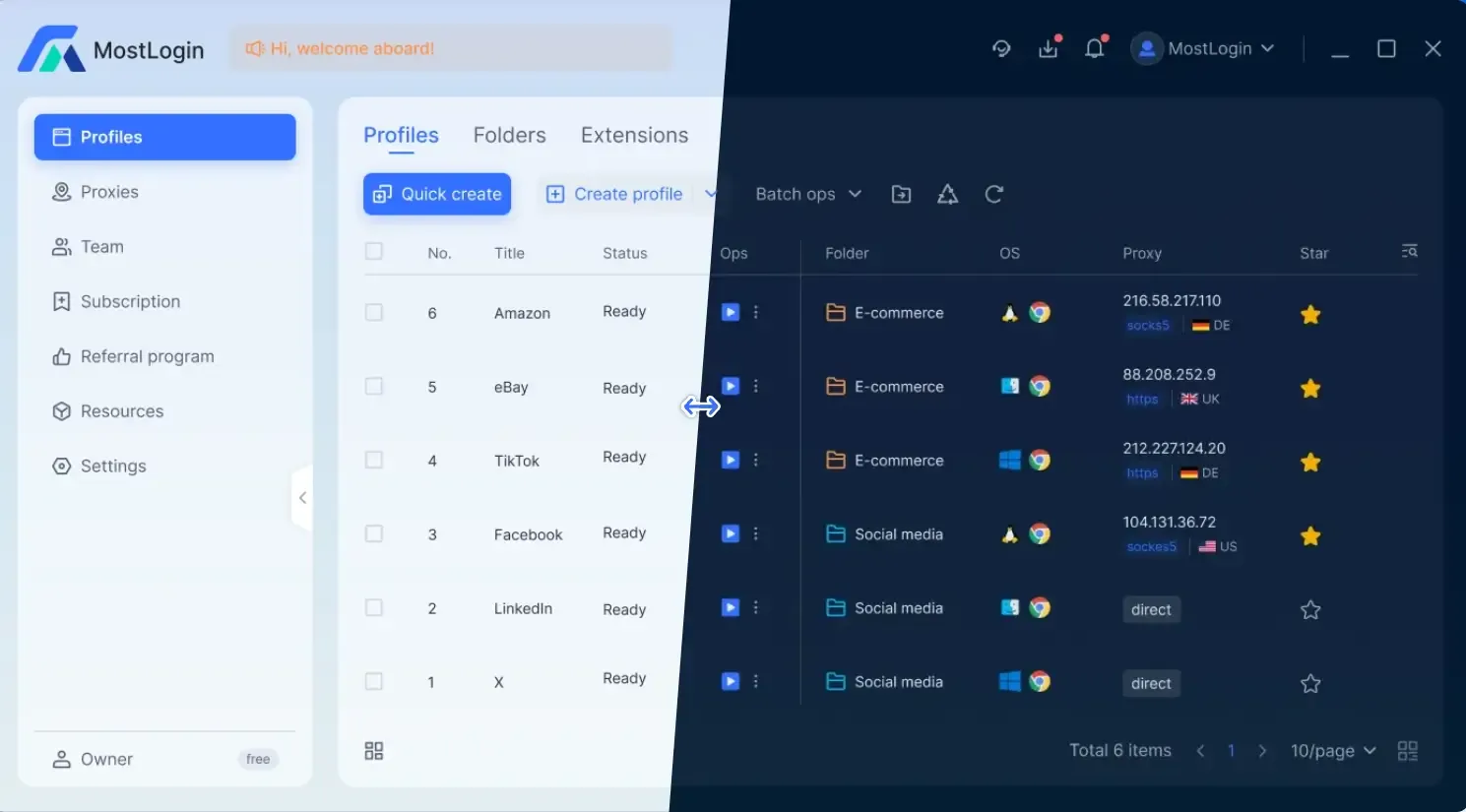
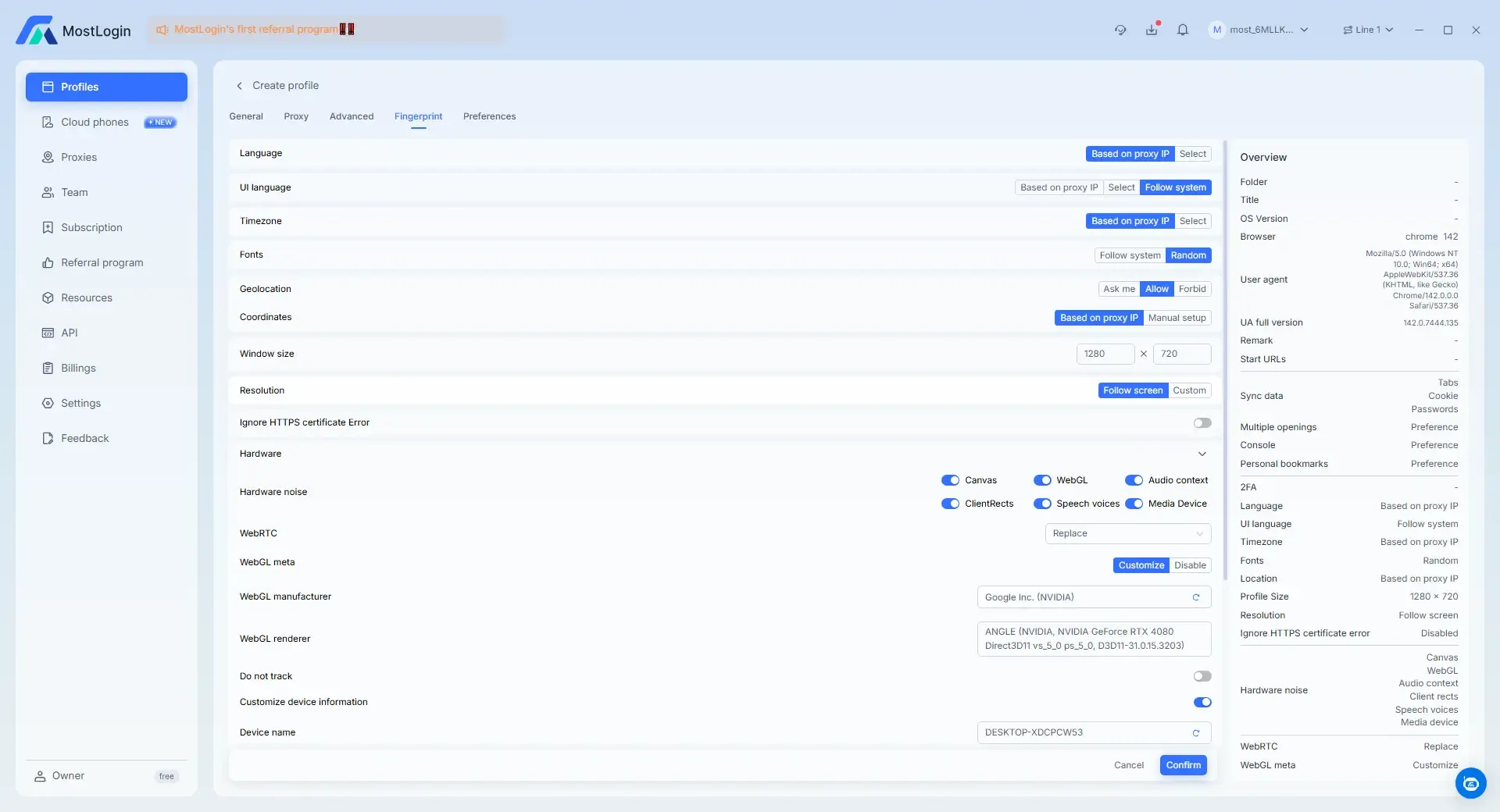
By protecting accounts in this way, we can make our multiple accounts more secure. In addition to setting up independent environments for multiple accounts, MostLogin Fingerprint Browser also supports configuring IP proxies for independent windows, as well as team collaboration and automated operation functions, which can improve overall efficiency while protecting account security.
7. More features of MostLogin Anti-Association Browser
Isolated browser environment: Each account runs in an independent window with unique Canvas, WebGL, User Agent, screen resolution and font fingerprints, ensuring that account operations do not interfere with each other and reducing the risk of account suspension.
Independent Cookie and cache management: Cookies, caches and local storage for each window are completely isolated, avoiding cross-contamination of data.
Advanced proxy management: MostLogin supports assigning independent proxy IPs to each account, hiding real addresses, simulating different geographical locations and breaking regional restrictions to maintain continuous security.
Multi-account matrix operation: One device can manage multiple accounts simultaneously, with each account operating as if on an independent real device, suitable for large-scale operation and team collaboration.
Team collaboration and centralized management: MostLogin supports role-based permission control and secure sharing of browser configurations, enabling efficient team management of accounts and activities, while tracking operational responsibilities.
Automated placement support: Compatible with tools such as Puppeteer, Playwright, and Selenium. Each automated task maintains independent fingerprints and proxies for secure batch advertising operations and data collection.
Conclusion
Virtual machines mostly solve the problem of parallel operation of multiple accounts. However, what platforms really care about is never whether you have switched to a virtual computer, but whether multiple accounts exhibit the characteristics of the same real user in terms of overall environment, fingerprint characteristics and behavioral patterns. We need to isolate accounts simultaneously at the network, browser fingerprint and behavioral levels to avoid account association and risk control as much as possible.
FAQ
Why are virtual machines easily detected by platforms now?
Because platforms do not only look at the operating system, but make comprehensive judgments based on browser fingerprints, network environments and behavioral consistency.
Does one virtual machine equal an independent device?
Not exactly. Virtual machines can only isolate the system layer and cannot automatically isolate browser fingerprints and behavioral characteristics.
Is it safe to use a virtual machine with a proxy IP?
Not necessarily. Low-quality or repeatedly used IPs are more likely to expose association risks.
What are the advantages of anti-association browsers compared to virtual machines?
It can isolate browser fingerprints, network environments and local data simultaneously, which is closer to the real user usage scenario.
MostLogin anti-detect browser tool helps users solve frequent problems such as multi-account operation, environment isolation and account risk control.
For operational questions, please refer to the Official Help Documentation